This is Learning

To learn is not to watch. To learn is to do. To fail and try again. To feel the cold water and the burning sun. To fish and not catch. To pitch a tent, use the fly as a ground tarp and to be “swimming” in your sleeping bag. This is learning.

I wrote this in the last article I posted back in May. Little did I recognize that two months later I would co-lead 17 teens on a three-week trip across Croatia and Slovenia. We hiked, biked, kayaked, white water rafted, zip lined, and camped. This WAS learning. Yet, as the days dwindled I found myself in contemplation about students perceived levels of comfort/discomfort, as well as perceived levels of effort. Seeing that many readers likely are beginning another academic year, I am hopeful this topic might push some buttons. Ones that lead to more green lights than red. Furthermore, I remind myself the role of resilience and how it doesn’t come from lessons or lectures. It’s forged in unfamiliar, uncomfortable situations where students learn to stretch themselves. Where we adults step back with intention, just enough to let growth happen.

The Stones Taught What the Pages Couldn’t

I was eager to learn more about Croatia, so I ordered a book about its rich history. Though I would spend more than 20 hours in flight, I could not wait to crack the book and I began reading. However, instead of turning the page or pages, I began to jump from the front to the back and then to the parts in between. Never really reading and definitely not comprehending. The 300+ pages read more like an academic text than a travelogue. The myriad of places, dates, and civilizations of antiquity, too complex to follow. And my skipping all around certainly did not help either.

Yet this all would change. Being in the places, hearing tour guides share stories, and rubbing my hand across the 15th century Venetian stones would allow me to connect the dots. An example of learning by doing. In Hawaii, where I live, it is not uncommon to hear this in the proverb, “Ma ka hana ka ʻike.” A great reminder that from day one this year, I want my students to be doing.

The Suitcase Won’t Fit — and That’s Okay

“There’s bugs!”

“My legs hurt.”

“There’s nowhere to put my suitcase in this tent.”

Two of three complaints uttered by the same student. Each met with compassion and the third with a bit of laughter. Yet, I remained poised enough to step back, but not out. Carefully determining when to intervene and when just to listen or observe. Avoiding the “rescue reflex,” and temptation to fix things quickly, what I found worked best was an honest, “I’m so sorry, can I help?”

“No, I’m fine.”

To be heard was often what simply appeared to matter most.

As the days turned to weeks, the complaints seemed to grow. There was especially a discomfort about not being able to control the little things in life. Like, when to wake up or what was for breakfast. And heaven forbid should we “three amigos” be split up in transport or at lunch! Some students even were comfortable to declare, “I may not be diagnosed (yet!) but I know I suffer from anxiety.” From experience I have seen an uptick in students (and adults) that have increased levels of anxiety. And research indicates how younger generations are more likely to report experiencing anxiety and other mental health conditions compared to previous generations. Yet, the word “anxiety” was being used three times as much as “please” and “thank you” and sometimes it felt as though the word ‘anxiety’ was being used more as a reflex than a reflection. Possibly as a shorthand for discomfort or loss of control.Such overuse diluting its clinical significance.

Effort and Reflection in the Classroom

So, coming back to the classroom. A little discomfort maybe is not a bad thing. It may just be  where growth begins. In Steven Kotler’s “The Rise of Superman” I recently read how “prodigies”, it seemed were made, not born. As Bloom (Benjamin Bloom, creator of Bloom’s Taxonomy), later told reporters, ‘We were looking for exceptional kids, but what we found were exceptional conditions.” I ask myself, what are those conditions? I hope to create them in my classroom this year.

Routine reflection will certainly take hold. One that allows for close scrutiny of perceived levels of effort. Often attributed to baseball great, Derek Jeter, there is truth to the quote, “There may be people who have more talent than you, but there’s no excuse for anyone to work harder than you do.” Getting students to honestly reflect on how hard they are working is something I certainly endeavor.

There is a definitive art to differentiation. Not everyone’s best efforts yield the same results. Taking the Delphic maxim of “To know thyself” one step further, teachers…Know thy students.

Belief and Flow

Something else I want to consider is the important role of truly and fully believing in each student,  Kotler imparts, “When someone believes you can do the impossible, it opens the door to believing it yourself.” “I want to be the kind of teacher who believes so fully in each student that they begin to believe in themselves and not just because I understand the psychological principle and power of how external beliefs often precede internal beliefs, especially in young or developing minds.

Third, besides reflection and empowerment, is to consider what Mihaly Csikszentmihalyi termed “flow”. Flow being that state of deep focus and enjoyment where you are fully absorbed in what you are doing, and time seems to disappear.  I want to be intentional about encouraging deep focus, understanding how flow requires concentration and uninterrupted time on task. As well, I want to continue to balance challenge and skill. For flow is said to arise when the task is hard enough to be engaging, but not so hard that it may cause what some students possibly were feeling in Croatia, anxiety. Furthermore, project-based learning will be a cornerstone in my classroom, inviting student autonomy.

With just a week before students arrive, I intentionally prepare, returning  to that simple truth: learning is not passive. It is often messy and at times, uncomfortable. But within that discomfort lies the space where growth happens. Kind of like the music being in the silence in between the notes. My role, then, is not to remove every obstacle, but to carefully create conditions where effort is expected, confidence in each student is unwavering, and where students can experience the deep satisfaction of flow. Whether in a classroom or on a trail in Croatia, the lesson holds: real learning happens not when we watch, but when we do. And this year, I’m ready to help my students do — and become — more than they thought possible.

###############

Who’s Gonna Carry the Boats? A Classroom Without Walls

Millions look idly on, as the man builds a shelter. He cuts the wood. He ties the knots. He lights the fire with one strike of the steel. His sons are with him. The Alaskan river runs cold and clear. As a family, they will fish. Eat. Sleep on the dirt.

All the while, millions remain locked to their screens. Out of the elements.

Screens Don’t Build Shelters

Is there little difference between this and so many classrooms?  The almost voyeuristic idleness and envy. Forget about all we might know about teaching, learning, and best practices. Throw out the window what may have been gleaned from Covid.  The default seems to be students remaining fixed to a chair. Often passive as they either listen to teachers talk, or moreover, are told what to do! Little if any exploration or autonomy. Passengers, they even request permission to go to the washroom.

In both instances, watching a family camp and being in a traditional classroom, the wind does not touch them. The earth does not stain them. The water does not wet them. They merely sit and watch.

Luke Nichols’ Outdoor Boys is all too familiar in how it connects with education.

Outdoor Boys is considered one of the fastest growing channels on YouTube, gaining more than 5 million subscribers in a 12-month period. Nichols’ videos have more than 6.8 billion views! However, recently Nichols said he was hanging it up because fame can be “overwhelming.” He plans to spend more time with his family.  His viewers? What will they turn to next? We need not worry. Voids are quickly filled.

Listening Is the Largest Slice

This past semester, I improvised at the start of a class and I asked students to draw a pie graph. Next, divide it up for how you see your average class and time spent practicing each of the following skills: listening, reading, writing, and speaking. Clearly there are so many other skills we are doing but for the sake of the exercise I just wanted to get a window into students’ perception. This was a big ask, as students have seven teachers. Yet, the overwhelming response is what readers might guess.  Listening was the biggest slice of the pie!

Passively listening feeds a similar habit of simply sitting in front of screens.  Clicking and swiping. Awaiting the next delivery of dopamine.  We teachers may talk of engagement but are the children truly engaged? They consume.

Downloading as opposed to uploading.

Floating in still water instead of riding the rapids.

Watching others camp while in the confines of a couch.

They look on as Luke Nichols builds a boat of logs and tarps. Then sails it down a river with his sons. And they love it. Nichols’ sons but also our students. The big difference being that one is doing it! And more often than not, it is not our students. It isn’t our our students who by in large are building the boats. As I write this I can’t help but hear the words of David Goggins’ famous motivational mantra, “Who’s gonna carry the boats?” The phrase said to have its origins in how Navy SEALSs carry heavy boats over long distances.

Are students willing to make the boats? Carry them?  If so, what might be standing in their way? I hope it is not I.

Let Them Feel the Cold Water

To think school is where the only learning happens would be a gross error. Years ago, 3 BIE (Before iPhone Era),  I was part of a larger conversation about what school was preparing students for. Merely for the transition into university or on a grander scale, preparing them for life? And if the later, what might this mean? The question rings just as true today. Surely it is far more than slapping a diploma in a young adults’ hands. What are students able to do?  And what could being cold teach them? Being a little hungry? So few students have ever tied a knot, lit a fire, or ever been lost.

To learn is not to watch. To learn is to do. To fail and try again. To feel the cold water and the burning sun. To fish and not catch. To pitch a tent, use the fly as a ground tarp and to be “swimming” in your sleeping bag. This is learning.

Building a boat and carrying it. This is learning. Not solely performing well on a standardized test.

Luke Nichols is authentic. He tells a good story and his passion and family values resonate with audiences. The natural world which viewers “experience” alongside him is also real. The creek is cold. The fish fight. The wood splits when you swing the axe right. Luke inspires connection, with nature, as a family. As well, what it might mean to embrace adventure.

What would a “creek-filled” curriculum look like?  Educators, administrators, and parents please make room for the creek. Make room for the mud and the silence and the weight of real things. Let’s break out of the four walls that contribute to the falsity of learning being a controlled experiment. Let’s let the students build…and not just in Maker Spaces. Let’s let them fail.

Let’s let them live.

The alternative is that they will only ever watch.

Want to dig in more?  Here are seven examples of engaged students:

St. Vrain Valley Schools – Innovation Center (Longmont, CO). Students collaborate with over 60 local tech companies on real-world projects, such as developing aquatic robots to study endangered species in Peru. They earn $10/hour while gaining practical experience in STEM fields

Smyrna High School Smyrna, Delaware, USA Engagement strategy: Six career pathway programs with internships and work-based learning to connect education to real jobs, increasing student motivation and engagement.

Coleman Culinary at The Depot – Coleman Community Schools, MI High school students participate in a hands-on culinary arts program, transforming a former restaurant into a classroom where they learn baking, sanitation, and customer service, gaining practical experience through catering events and community dinners.

High Tech High Chula Vista – Chula Vista, California, USA (browse projects) Engagement strategy: Project-based learning integrated school-wide, including extensive internships where students work 30+ hours weekly with local businesses.

School of Environmental Studies (Apple Valley, MN)Known as the “Zoo School,” students participate in interdisciplinary, project-based learning with an environmental focus, including field studies and senior capstone projects that address real-world environmental issues.

United World College of the Atlantic – Wales, UKSituated in a 12th-century castle, UWC Atlantic is part of the global United World Colleges network. The school combines academic rigor with experiential learning, offering courses in sustainability, peace studies, and global citizenship. Students engage in service projects and outdoor education, fostering leadership and a commitment to social responsibility

World Economic Forum (WEF)Though a few years old, WEF selected 16 schools as models pioneering the future of education, reaching nearly 2.5 million children worldwide with new learning approaches. This is worth a read.

##################

Listening to Learn with a Bold New Commitment to Clarity

“Uncle Matt? Hi! Can you talk?”

Teaching runs deep in my family. My mom and aunt were teachers, and when I followed in their footsteps, they couldn’t have been prouder. So, when my niece recently joined the ranks, it filled me with satisfaction. Just the other day, she shared a video of her classroom. Newer to the profession her excitement and uncertainty are palpable.

She followed up by calling me because she wanted to discuss something that had caught her off guard. During a back-to-school professional development session, the faculty delved into the topic of late work—a conversation that quickly heated up, with a strong focus on “policies.” This word, heavy with implications of compliance and authority, contrasted with my niece’s more collaborative approach, grounded in mutual respect and agreements with her students. After our call ended, I couldn’t shake the feeling that this was just one of many critical discussions that hopefully we are having before students arrive. Otherwise, it is likely to be overshadowed by more pressing issues which likely could be headed off with these early conversations and agreements. I share my niece’s idealism and agree that it is vital for teachers, administrators, and parents to unite and have a shared vision, working together for the best interests of students. Otherwise, an already complex world becomes even more difficult to navigate.

Open Dialogue, One Key to Student Well-Being

Writing this is not meant to be limiting. It really isn’t about my niece’s school or even late work policies and protocols. Rather, it is about the critical nature of sharing a unified vision and mission, understanding how important it is that we are in alignment and that we are as consistent as possible with expectations and follow through. This is what allows students a bit of space to relax. A space which is increasingly more and more needed in our world today. When we all are on the same page, our cohesion fosters student growth, reinforces core values, and helps students achieve beyond their school goals.  Hopefully there is then a transfer into all areas of their lives, now and in the future.

A recent reputable education journal (I won’t say which one, nor will I share the title) featured a piece where a teacher professed how she hard and fast, simply would not allow AI this year. Such conversations on whether or not we allow students to use AI, largely should be mute. I say this, because simply we cannot (nor should we try) stop the use of AI. This is not pessimism speaking, but rather reality. And if we cannot stop it, there is even more impetus to educate on how to responsibly use it.

Consistency as a Compass

The more my niece talked, the more she seemed to be drilling deeper down in dismay about her school’s inconsistency and scattered beliefs about late work. I assured her that schools across the globe; public and independent are in a similar situation.  When I asked her for some cold and hard data, I was grateful for her  passing along a Google Sheet where teachers responded to the prompt, “Please add your late work policy for your classroom to this document by tomorrow morning.”

My niece was right. There was a wide degree of difference. I decided to use ChatGPT 4.0 to analyze the data and here is what was generated:

Strict No Acceptance:
Some policies state that late work will not be accepted at all unless prior arrangements have been made, emphasizing the importance of meeting deadlines without exceptions.

Harsh Penalties:
Several policies impose significant grade deductions, such as a 10% penalty per day or up to 50% off for work submitted late, which can be severe for students who miss deadlines.

High Flexibility:
On the other end, some policies allow late work to be submitted at any time, with minimal or no penalties, or even full credit up until a certain cutoff (like the end of the quarter).

In Eurasia Review Mir Hassan and Malik Kumail write, “ In an era of constant change, consistency remains the compass that guides students on their educational journey, laying the groundwork for a successful and fulfilling life.” These faculty responses depicted that there was little consistency. Maybe a bit of vision was lacking too. Some teachers possibly could see the forest through the trees whereas, others only saw the trees. This left me wondering, with such a mixed bag of visions and practices, how confusing might this be for students?

“Here I can. There I can’t. Tomorrow is okay but not in two days. 10% in his class and 50% in hers.”

I decided to speak to a colleague at another school and enquired about how their school treats late work. She shared, “Not all faculty could agree. However, since the decision was made, they all agree on the importance of being consistent.” Her school subtracts 5% per day after the due date, but not more than 35%.

Discourse Across Difference

Maybe one of the questions we should be considering is, “How might we provide greater clarity of expectations to and for students?” To do so, means we begin conversations like my niece was having. This undoubtedly requires listening but also flexibility. Something may have to give. And that something might just be us!

Global Online Academy’s (GOA) mission is to reimagine learning to enable students to thrive in a globally networked society. Recently, they announced several new courses will be offered. One is titled, “Discourse Across Difference.” How valuable might this be! For my niece’s school but for all of us? The course description reads, “Our increasingly interconnected, globally networked society presents us with complex social, political, and ethical dilemmas. This course equips students with strategies for engaging such issues through constructive dialogue focused on building understanding across differences…” How much better off might we be if we begin to have more of these conversations and eagerly begin to listen to learn?

I continue to reflect on my conversation with my niece. What is most clear, is that these conversations are more than what they appear. Ultimately, how we have them, can similarly occur in our classrooms. This is the learning environment our students need. As educators, we have a responsibility to cultivate clarity and consistency in our expectations. This begins with the discussions we have among ourselves. If we’re willing to listen and adapt, to see beyond our classrooms and consider the broader impact of our decisions, maybe we can create more supportive and cohesive experiences for our students.

The Need for Courage and Openness in a BANI World

In the post-Cold War era and the 1980s, the VUCA model (Volatility, Uncertainty, Complexity, Ambiguity) appeared. Few would disagree how the world seemingly become even more VUCA-filled. Yet, WU Executive Academy imparts how post-COVID-19, VUCA has evolved to BANI (Brittle, Anxious, Non-linear, Incomprehensible). Barbara Stöttinger, the dean of WU Executive Academy is not pessimistic. “BANI can be answered by the skills that we call ‘pioneers’ qualities…’ Successful leaders must face their own emotions and anxieties to prevail.” Courage and openness towards new things are two necessary traits.

Could we, as educators, take a page from my niece’s book? Being courageous and open enough to start these essential conversations. And then to reflect on them. Ones that call for less “my way” and more curiosity, flexibility, and collaboration. Our students’ best interests depend on it.

Listening to Learn with a Bold New Commitment to Clarity

“Uncle Matt? Hi! Can you talk?”  

Teaching runs deep in my family. My mom and aunt were teachers, and when I followed in their footsteps, they couldn’t have been prouder. So, when my niece recently joined the ranks, it filled me with satisfaction. Just the other day, she shared a video of her classroom. Newer to the profession her excitement and uncertainty are palpable.  

She followed up by calling me because she wanted to discuss something that had caught her off guard. During a back-to-school professional development session, the faculty delved into the topic of late work—a conversation that quickly heated up, with a strong focus on “policies.” This word, heavy with implications of compliance and authority, contrasted with my niece’s more collaborative approach, grounded in mutual respect and agreements with her students. After our call ended, I couldn’t shake the feeling that this was just one of many critical discussions that hopefully we are having before students arrive. Otherwise, it is likely to be overshadowed by more pressing issues which likely could be headed off with these early conversations and agreements. I share my niece’s idealism and agree that it is vital for teachers, administrators, and parents to unite and have a shared vision, working together for the best interests of students. Otherwise, an already complex world becomes even more difficult to navigate.


Open Dialogue, One Key to Student Well-Being

Writing this is not meant to be limiting. It really isn’t about my niece’s school or even late work policies and protocols. Rather, it is about the critical nature of sharing a unified vision and mission, understanding how important it is that we are in alignment and that we are as consistent as possible with expectations and follow through. This is what allows students a bit of space to relax. A space which is increasingly more and more needed in our world today. When we all are on the same page, our cohesion fosters student growth, reinforces core values, and helps students achieve beyond their school goals.  Hopefully there is then a transfer into all areas of their lives, now and in the future.

A recent reputable education journal (I won’t say which one, nor will I share the title) featured a piece where a teacher professed how she hard and fast, simply would not allow AI this year. Such conversations on whether or not we allow students to use AI, largely should be mute. I say this, because simply we cannot (nor should we try) stop the use of AI. This is not pessimism speaking, but rather reality. And if we cannot stop it, there is even more impetus to educate on how to responsibly use it.


Consistency as a Compass

The more my niece talked, the more she seemed to be drilling deeper down in dismay about her school’s inconsistency and scattered beliefs about late work. I assured her that schools across the globe; public and independent are in a similar situation.  When I asked her for some cold and hard data, I was grateful for her  passing along a Google Sheet where teachers responded to the prompt, “Please add your late work policy for your classroom to this document by tomorrow morning.”

My niece was right. There was a wide degree of difference. I decided to use ChatGPT 4.0 to analyze the data and here is what was generated:

Strict No Acceptance: Some policies state that late work will not be accepted at all unless prior arrangements have been made, emphasizing the importance of meeting deadlines without exceptions.

Harsh Penalties: Several policies impose significant grade deductions, such as a 10% penalty per day or up to 50% off for work submitted late, which can be severe for students who miss deadlines.

High Flexibility: On the other end, some policies allow late work to be submitted at any time, with minimal or no penalties, or even full credit up until a certain cutoff (like the end of the quarter).


In Eurasia Review Mir Hassan and Malik Kumail write, “ In an era of constant change, consistency remains the compass that guides students on their educational journey, laying the groundwork for a successful and fulfilling life.” These faculty responses depicted that there was little consistency. Maybe a bit of vision was lacking too. Some teachers possibly could see the forest through the trees whereas, others only saw the trees. This left me wondering, with such a mixed bag of visions and practices, how confusing might this be for students?

“Here I can. There I can’t. Tomorrow is okay but not in two days. 10% in his class and 50% in hers.”

I decided to speak to a colleague at another school and enquired about how their school treats late work. She shared, “Not all faculty could agree. However, since the decision was made, they all agree on the importance of being consistent.” Her school subtracts 5% per day after the due date, but not more than 35%.  


Discourse Across Difference

Maybe one of the questions we should be considering is, “How might we provide greater clarity of expectations to and for students?” To do so, means we begin conversations like my niece was having. This undoubtedly requires listening but also flexibility. Something may have to give. And that something might just be us!  

Global Online Academy’s (GOA) mission is to reimagine learning to enable students to thrive in a globally networked society. Recently, they announced several new courses will be offered. One is titled, “Discourse Across Difference.” How valuable might this be! For my niece’s school but for all of us? The course description reads, “Our increasingly interconnected, globally networked society presents us with complex social, political, and ethical dilemmas. This course equips students with strategies for engaging such issues through constructive dialogue focused on building understanding across differences…” How much better off might we be if we begin to have more of these conversations and eagerly begin to listen to learn?  

I continue to reflect on my conversation with my niece. What is most clear, is that these conversations are more than what they appear. Ultimately, how we have them, can similarly occur in our classrooms. This is the learning environment our students need. As educators, we have a responsibility to cultivate clarity and consistency in our expectations. This begins with the discussions we have among ourselves. If we’re willing to listen and adapt, to see beyond our classrooms and consider the broader impact of our decisions, maybe we can create more supportive and cohesive experiences for our students.   The Need for


Courage and Openness in a BANI World

In the post-Cold War era and the 1980s, the VUCA model (Volatility, Uncertainty, Complexity, Ambiguity) appeared. Few would disagree how the world seemingly become even more VUCA-filled. Yet, WU Executive Academy imparts how post-COVID-19, VUCA has evolved to BANI (Brittle, Anxious, Non-linear, Incomprehensible). Barbara Stöttinger, the dean of WU Executive Academy is not pessimistic. “BANI can be answered by the skills that we call ‘pioneers’ qualities…’ Successful leaders must face their own emotions and anxieties to prevail.” Courage and openness towards new things are two necessary traits.  

Could we, as educators, take a page from my niece’s book? Being courageous and open enough to start these essential conversations. And then to reflect on them. Ones that call for less “my way” and more curiosity, flexibility, and collaboration. Our students’ best interests depend on it.

The Quest for Authentic School Identity

This year our school marks 75 years, and at our first meeting, we began with something simple but powerful. After ample opportunity to swap summer stories, we slowed ourselves enough to come to a complete pause. In the silence, the true identity of our community came into focus. The activity, one of strategic planning, struck me as we considered not so much the importance of where we’ve been or even where we are presently. The emphasis instead was on WHO we are! Gaining such clarity was not just for us; but for the students.


As a high school teacher, I consider myself fortunate to have taught in seven schools, on five continents, each with its own identity. Knowing a school’s identity matters and surprisingly, or not,  the story being told by marketing and web pages sometimes is not what exactly plays out “on the ground.” Years ago I simplified the international school scene into what is often referred to as a tiered system. I have since traded this in for the concept of “fittingness.” Certain regions may be considered as having the “best” packages. Others may have reputations and even tout premiership because they funnel more students into Ivy schools. Whatever the case, it all is rather superfluous. Instead, I prefer to consider a school’s identity, whether or not they really are doing what they say they are, and what ultimately is the best fit for me. The school with me and me with the school.


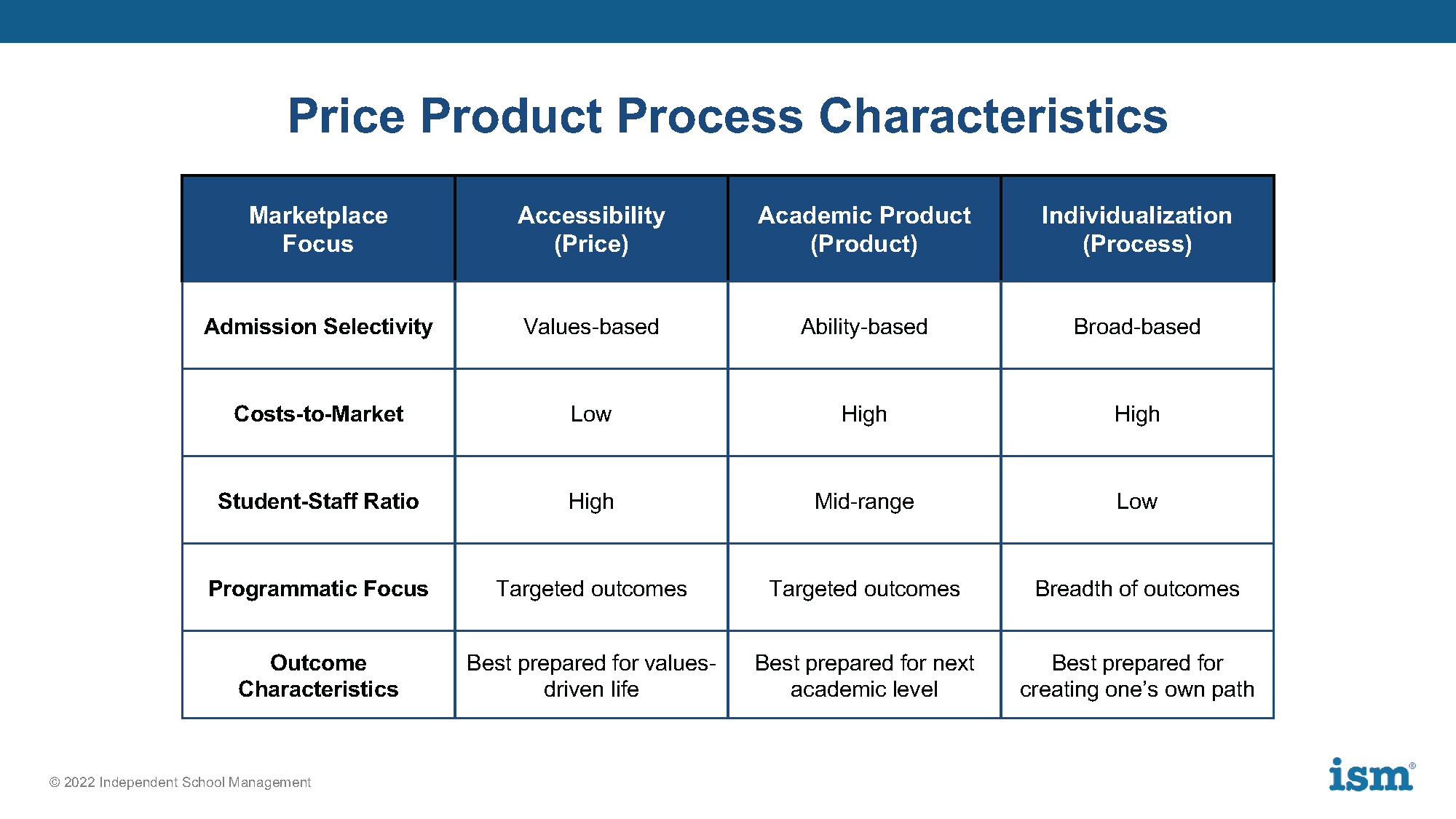
The activity we were doing this opening day was a reflection upon the type of school we were: price, product, or process? For decades, Independent School Management (ISM) has called it a basic marketing truth and advises, “private-independent schools can compete on the basis of price, product or process, but not on the basis of all three at the same time”. We silently looked upon the following, asking ourselves, “Who are we?”

Unified Purpose in Value-Based Schools

Price or Value-Based Schools are often faith-based. They focus on shared values and community. Tuition is lower, making them accessible. In the value-based school where I taught, the community was close-knit. Education was far more than the math, science, and social studies students learned. It was about morals and ethics too. Though we had the benefit of being a small school, I could say with confidence that everyone—staff, students, parents—shared the same purpose. Staying true to this identity means keeping that sense of belonging strong and making sure the school’s values show in everything it does.


Pressure and Performance in Product Schools

Product Schools are predominately centered on academics. They take in top students and push for the best results. It’s tough, and the stakes are high. In the product school I experienced, the ethos was one of “learn, learn, learn.” The pressure was constant—on both students and teachers. But the results were there: top colleges and high test scores, however sometimes at the cost of joy. However, this need not be the case. Staying true to this identity means keeping up the academic rigor but also remembering that there’s more to education than just grades. Balance matters.


Understanding Our Process School Identity

Process Schools focus on how students learn, not just what they learn. They help students find their strengths and give them the support they need. It’s about opportunities and students being encouraged to dabble in a little bit of everything. Personalization and belonging are both cornerstones, as is the importance of keeping class sizes smaller.

As we looked at the chart and reflected, it appeared so clear to me that we are a process school. However, I was keenly interested to hear from colleagues as we turned and talked. A few shared comments that leaned towards us maybe being more of a product school. “Preparatory” after all was in our school’s name. These conversations were quite beneficial as the space created was not filled with efforts to convince one another.  Rather, to more fully examine perspectives and better define who we are as a school.


The Lesson of Pole Pole

I’ve learned this: a school must stay true to who it is. Whether it’s built on community values, driven by academic success, or focused on each student’s journey, the mission has to be lived every day. As teachers, our job is anything but simple, however, it is essential that what we believe matches what we do. That’s how you build a strong school, where everyone can thrive. Schools living up to their mission and vision is akin to climbing a mountain, it’s not about rushing. This summer as I climbed with students to nearly 20,000 feet, I learned an essential phrase in Swahili, “Pole pole,” which means go slowly. Might there be value in reminding ourselves of Peter Senge’s famous law from the Fifth Discipline, “Slower is faster”?  Regardless of your type of school, taking time with students is fundamental.


Pole Pole. Afterall, it is how relationships are formed.


Wherever you might be in the world, as summer wanes and another school year gets underway, I hope you might similarly reflect on your school’s identity. Furthermore, may your year with students be enjoyable as you climb up the “mountain.” With care and purpose, keeping eyes and hearts fixed on what truly matters. Not the summit but students and the learning journey before you!


Pole Pole.

###########################

AN END TO GATEKEEPING AS WE SOAR INTO 2024

My final article of last year was a contemplation of the need for a radical shift in education, advocating for a departure from traditional structures. One focused on responsibility and an optimistic mindset. Without focused intention, I seemingly then followed up by writing about the underpinning importance of spirit and the value of authenticity. At midnight tonight, we will welcome 2024 and I am curious what the year ahead holds in store. My best guess? An increasing awareness and an availing of oneself in an age where gatekeeping no longer has a place. The word “gatekeeper” may just be the quintessence of 2024.

The Continual Changing Landscape of Education

The past week on several occasions the word “gatekeeper” surfaced. It is highly sensical too when we consider how anyone is now able to self-publish. Consider the ubiquity of not only social media but how an individual can reach over 160 million people/followers on a platform like TikTok. Or, how Tik Tok now has over 1 billion subscribers! Further, consider the rise of the rise of Artificial Intelligence (AI), and how it continues to revolutionize content creation. Not only is it faster and more efficient, but it also is becoming more accurate. The point is, if you have something to share, you not only have an audience but are free to share.

Essentially, gatekeeping is defined as the practice in which a hierarchy of power holds power and can limit access. My initial understanding of how the world was changing in a very practical sense occurred as I traipsed the world back in 2011. Irrespective of location, be it in the Atlas Mountains of Morocco or the Amazonian River Basin of Ecuador the response to, “How did you learn English?” was always the same. “English” could be substituted for beekeeping, dancing, cooking, or any other skill, and yet the response was always…

“YouTube.”

Long gone are the days when an institution, course, or teacher is necessary. Nor is the cost of learning a deterrent. An internet connection and time are all that are required. Individuals with the will to learn something, anything, have been doing it for more than a decade. This second millennium allows us the opportunity to move through time and space differently. Access, not gatekeeping is where we are now. And access even to what is considered “the best.” For example, Yale no is longer limited to just Yale students. “In recent years, Yale has expanded its offering, including the online Coursera classes which are estimated to have over one-and-a-half million students in 2023.”  Specific to education, the term gatekeeping is about controlling the rate at which students progress to more advanced levels of study in the academic setting. Thankfully, learning as we know it, is no longer limited to institutional settings. Not only can we learn anything, from anyone, anywhere, and at any time, but we are also free to progress at the most fitting rate.

Technology’s Influence Unveils a World of Choice

One might go so far as to say there is a “movement” underway. One rooted in choices. Just consider how we continue to see an upswell in such choices as this abbreviated list:

  • Online Learning Platforms: Platforms like Coursera, Udemy, and Khan Academy
  • Micro-Credentials and Badges
  • Homeschooling and Unschooling
  • MOOCs (Massive Open Online Courses
  • Gamified Learning

*Note: Udemy alone registered 870 million course enrollments as of June 2023

Inherent in each is the removal of the traditional gatekeeper. Such choices have however elicited a question concerning credentials and their verification. James Mattiace expounds in The Global Credentialing Landscape: Messy, Massive and Meaningful, “The world is getting more complex. Different countries are adapting their educational and professional certification programs and there is a proliferation of fraudulent credentials, which will likely get worse before it gets better as we enter an increasingly AI-infused world.” Whatever the case, we need not be reminded that there continues to be great value in access to non-traditional, credit and non-credit learning experiences continues to increase.

Education’s Real-World Power

It might serve us to follow the mindset of influential worldwide leader, Jeff Bezos. On more than one occasion he shared, “I have learned to use the word ‘impossible’ with great caution.” 2024 is about possibility. Not only are all things possible, but quite probable. A look at the “real world” tells us so. As part of my formal training as an educator we were assigned to read Paulo Freire’s “Pedagogy of the Oppressed.” Though the book had a profound impact on me, it was minimal in comparison to what I learned from my practicums and working in a diversity of settings. Settings that were very different from the theoretical university classroom or that which I had experienced growing up. Over the course of a year, I would experience four 3-month rotations in settings where I would be with children growing up oppressed. In schools where students were the sons and daughters of seasonal migrant workers, in schools where 100% of the students received free lunch (and often breakfast too!), and also in schools where I would support severely and differently-abled students who were mainstreamed. This was the “real world”. The best teacher would be the setting and the children, in accordance with what Freire believed education to be. An education that he quoted as “freedom.” Not the formal school curriculum which he distrusted. This quote, “Education is freedom” is as timeless as it applies to today. A learning which supersedes the heads and hearts of academics, but is more about the hands and feet on the ground. It is about doing the work now. A clear realization and also trust that all that is needed already exists. Pivotal in this is the reality of humanity’s resilience. To attempt to hold this back, or in other words “gatekeep” is misguided.

 Answers Not in Dollars but in “Sense” 

“You hear that Mr. Anderson?” is a memorable line from The Matrix that many readers might remember. The query comes as Agent Smith holds Neo’s (Mr. Anderson) hand on the train track. The sound of the train thunders towards them. “That is the sound of inevitability!” threatens Smith. Yet, Neo defies the odds and does not succumb to death. His strength is akin to what is held in store for today’s youth. Africa’s youth but one possessor of the palpability of power, wisdom, and resilience. Such spirit can be seen in Ugandan children’s dancing. The video is not meant to be tokenism nor reductionist but simply showcase the electrified sense of vibrancy, life, and possibility. The children soon will be part of Africa’s working force. I hope that the remnants of colonialism will not act as gatekeepers.

By the late 2030s, sub-Saharan Africa’s working-age population will reach 1 billion. Though India overtook China this past year, both with nearly one and a half billion people, sub-Saharan Africa’s population will soon outrank both.  What might this mean? Hopefully a compelling sense of urgency to invest educationally. And yet, how this might look, might require a bit more imagination or possibly radical simplification. A desire to color outside the lines, and not necessarily abide by unsustainable practices traditionally attempting to place band-aids on gaping wounds. Instead, how might we create choices within communities? Tap into the expertise and wisdom of elders. The answers are not in dollars but in sense. The sense of inside out and not outside in. An understanding that everything needed already exists.

Might 2024 not only be a decline in gatekeeping but also a greater realization the world over, of our greatness. The Master Persian Poet Rumi said it best:

“You were born with greatness. You were born with wings. You are not meant for crawling, so don’t. You have wings. Learn to use them and fly.”

So, let us soar into 2024.

###############################

How to Cultivate Belonging in Online Spaces

As a writer, I am often reminded to keep the main thing the main thing. It is no different for education. No matter how we may dice it, the main thing is, was, and always will be relationships. Research brims with evidence supporting the fact that people are more likely to learn from those they know, like, and trust. The impetus for transferring this understanding might simply be an invitation for teachers to be their authentic selves.


Whatever the latest buzz, hopefully we are not distracted from the main thing. The fact is that education ultimately comes down to people. People are dependent on feeling like they belong, a part of a community. To develop such community, especially in an online setting, is artistry but also requires intentionality. Community and belonging do not just happen.    


So, how might we create classrooms, or better yet, experiences where students know but also feel that who they are matters? At Global Online Academy (GOA) courses bridge students from a diverse set of economic and cultural backgrounds, while also juxtaposing asynchronous and synchronous learning across various time zones. We might end up connecting at 6pm in Hawaii, while it is 7am in Riyad, Saudia Arabia. Yet are we really “connecting.” Meaning, how might we intentionally design learning so relationships are forged, so the reality of community can emerge? 


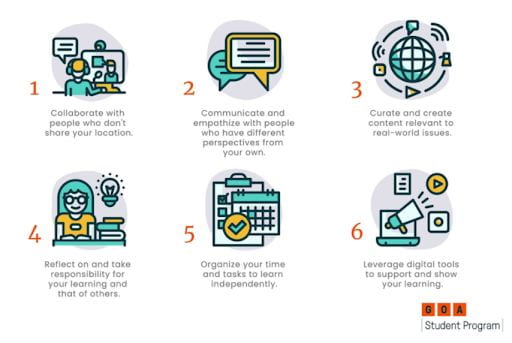
Keeping six core competencies on our dashboards, front and center, it behooves us to consider how we might foster collaboration with people who don’t share our location. Early and often! As well, how will we provide opportunities for students to communicate and empathize with people who have different perspectives from their own? Further, how might we leverage digital tools to support and show learning? All three competencies are concentrated on, in an effort to build a culture of learning. A culture grounded in trust. Where the foundation is more a “we” than “me” mindset. Inherent in this work is also the competency to reflect on and take responsibility for our learning but also the learning of others. 

To accomplish all of this is akin to painting Starry Night. Maybe even while peering up at a cloudy midnight sky. Yet, if we keep the main thing the main thing, we might be surprised by our inner van Gogh!

From Theory to Practice

One of Einstein’s many famous quotes was, “In theory, theory and practice are the same. In practice, they are not.” This illustrates how there is a difference between abstraction and actual application. Like talking about riding a bike and actually riding one. If the purpose again is the “main thing,” relationships, it seems sensible that application or how we might go about this be considered.  


In an in-person setting, there is a higher probability for relationships to organically happen. In the hallways, at lunch, or possibly with the person sitting next to who the teacher says is your “turn and talk” partner. However, online relationship building is clearly different. Anyone who was learning, working, or teaching during the pandemic (that’s all of us!) likely already knows this. They lived it. YOU lived it! For all we may have learned from online learning and working, there seemingly was a quick recoil to 2019 and an illusion that we could just “go back to normal.” The same as it ever was, a reminder of the Talking Heads waxing poetic in, “Once in a Lifetime.”  

Into the blue again, after the money’s gone

Once in a lifetime, water flowing underground

Same as it ever was, same as it ever was.


Only, nothing ever returns to the same as it ever was.


Instead, the world as we know it is one where the systems are fast dissolving. Knowing this firsthand, we have a sort of moral obligation to create online opportunities to support learners in developing relationships. Not just student to teacher, but student to student.


In our Entrepreneurship in a Global Context GOA course, the first weeks are crafted in a way that students are introduced to content, and yet the design is principally around building culture. Our culture as a class, one which seems to seamlessly parallel what we refer to as, the mindset of an entrepreneur. What surfaces are characteristics such as passion, awareness, and the importance of feedback.


TWIST and Shout!

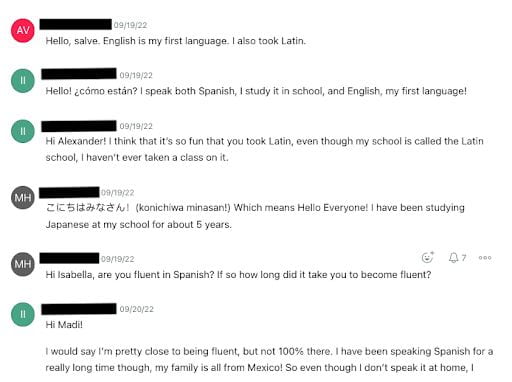
PEW Research Center reported how in 2010, 72% of all teens text messaged. Surely in the last twelve years, this number has only risen. Informed of this preferred communication style, GOA was wise and embraced a platform or “tool” for students and teachers to communicate “informally.” Twist, an async messaging app helps make collaboration easy as learners are spread across the globe. With Twist, conversations are organized into threads, supporting students as they reach out one to another socially but also collaboratively in their course work. The idea we inherited from previous course designers is in effort to familiarize students with Twist, however, the purpose is twofold in that not only do students begin to feel more comfortable with the app, but they also begin to create community. A few tasks are asked, below are two examples:


–In #RANDOM CHATTER (the channel) post a pic of a food from your region (dish from a specific restaurant? Iconic food of your region? Meal you’d cook?). Then, tell us why you picked it.  

–Go to your Twist group. Mr. Piercy (me!) sent you all a message in it. Do you see it? Share hellos with your group in each language you fluently speak or are studying. ( i.e from Mr. Piercy: “Hello, Buenos dias.” (English is my first language but I am fluent in Spanish). *Watch that Twist channel space. Use that space. Have a question? Want to know others’ thoughts? Wonder if you’re on the right track? Have something to share? Challenge yourself to reach out at least twice over this module in that channel. And please, listen to others and respond when they post.


Discussion Boards

With all differing process speeds, asynchronous discussions elicit a depth of thought that might otherwise not be possible. Students are asked to post their thinking but also take the time to listen, or in effect, read what their classmates are saying. Often, initial student responses tend to be simple affirmations. We challenge students to bend away from the “I agrees.” Considering global contexts, discussion boards are “fertile ground” for students to develop different perspectives. Further, might they share anecdotes, include observations, and even share resources? The idea is to extend each other’s learning. As one community. 

Of course, careful consideration is to be taken in when designing pre-activities and questions. This is to spark a depth of discussion. A discussion that ultimately promotes connection.  

Video Cannot Be Overlooked

The Buggles’ 1979 debut single, “Video Killed the Radio Star,” centers on a concern for how 20th-century inventions might alter life and lead to the generation of today possibly not appreciating the past. Besides the catchy jingle, the song title is repeated 17 times over the course of a little more than three minutes. “Video Killed the Radio Star,” was decades before YouTube and TikTok. It even predated the days of “Be Kind and Re-wind” and the VHS (bonus: VHS stood for Video Home System). Yet, The Buggles were on to something. There would be little looking back and video was here to stay. So much so, that instead of looking back, it would become commonplace to have a kinked neck because of our looking down; at phones!

Fast forward to today and the use of video. To consume but also create.  The New York Times reports, “TikTok is already the world’s most downloaded app for those ages 18 to 24.” So ubiquitous that in September of 2021, global statistics reported 1 billion monthly users


To know this is to own it. 


We as educators have an obligation to utilize the medium of video. In a GOA course, consistent attention must be paid to being personable. How might teachers and students alike present our “real” selves? One idea, borrowed from colleague Jim Burns, is the “One Minute, One Take.” This broad brush stroke introductory video at the start of each module drips with authenticity. Following this, embedded throughout the module are other purposeful videos. Some more tutorial-based, others clarifying, or possibly even explicitly teaching. The flavors and textures of the videos are different, while the common denominator is what lies behind. This notion of connectedness, always remembering to keep the main thing the main thing, relationships.


Reflecting Forward

Students also have a chance to feature their bad hair, blunders, and “real” selves as they are asked from time to time to create videos too. In an effort to get to know students better, at the end of our first module, students do a 3-minute or less reflective video. They are asked to just talk to the camera, as well they are given a few prompts to consider. For example:

~what are your biggest takeaways?

~how has your thinking shifted relative to x, y, or z?

~what were the influences on how your thinking is changing?


There always is an invitation to share lingering questions, challenges that have arisen, and anything exciting in their lives. I recently heard about twin sisters, volleyball matches, and even a 3-day sail up the coast of Croatia.  

https://youtu.be/4tL66uwoEP4

A sort of celebratory closure is a video response in return for each student. Likened to a 1:1 conference, only asynchronous and through the well-received medium of video, this helps personalize learning. Yet one more shift in practice to hopefully add to that feeling of belonging. Mindful to keep the main thing the main thing.

###############

UNITED IN EMOTION, IMMERSED IN HUMANITY

Barshim

Biles

Hubbard 

Tamberi

Tsimanouskaya.

Names to remember but moreover examples for our students to follow.


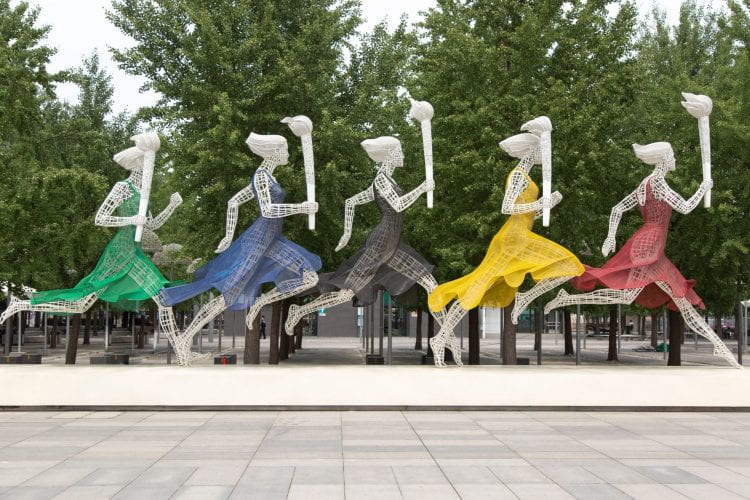
Qatar, United States, New Zealand, Italy, and Belarus. The athletes represent five different countries and five different events.  Each individually could be envisaged as   one of five olympic rings.  Their stories, like the rings, intertwined and embodying hope.  A heroism that supersedes athleticism, for they are harbingers of the dawning of a more humane future. 


Olympic History 

In 2012, the motto of the London Olympics  was “Inspire a Generation.”  In 2016 in Rio it was “A New World.”  How befitting that this year in Tokyo the motto was “United by Emotion.”  Originating in ancient Greece as many as 3,000 years ago, the games have not lost significance socially or culturally.  Yet, there was a hiatus in the Olympics in 393AD under the reign of Emperor Theodosius as the ancient pagan Olympiad system was disbanded. Not until 1896 were they revived.  

According to the International Olympic Committee, “Olympism is a philosophy of life, exalting and combining in a balanced whole the qualities of body, will and mind… Olympism seeks to create a way of life based on the joy found in effort, the educational value of good example and respect for universal fundamental ethical principles.” A lofty goal if we think back to the original games where all all athletes competed naked and corporal punishment awaited those “guilty” of even a false start on the track. This summer 200 nations convened in Tokyo for the XXXII Olympics, competing in 339 events, or 33 sports, over the course of 16-days. Much more than victory or failure, the Olympics are unable to be distilled to a single element.  They are a spirit. One in which may bear witness to the good, the bad, and the ugly.  


Generosity and Sharing Joy

Mutaz Barshim and Gianmarco Tamberi set an example of what is possible when we set ourselves aside, our maniacal egos, and consider that winning does not necessarily indicate someone must lose. The high-jumping duo have a history of competition but more importantly friendship. Each has battled hardships in their career and received support from the other.  So, after both successfully cleared the 2.37m mark, a “marathon” two-hour attempt to outdo the other ensued.  Until finally, an Olympic official offered them a jump off to see who would prevail.  Time seemed to slow as Barshim questioned, “Can we have two golds?”  Almost in perfect unison with the response, “It is possible,” Tamberi leapt into the arms of Barshim.  Nicole Jeffery for World Athletics described how Tamberi then tore off on a hop and a skip across the track, before finishing up in a pile on the floor in floods of tears.  The headlines would read, “High jumpers sharing gold medal dubbed ‘the greatest moment in Olympic history.” Watching the video leaves the viewer with warm feelings of just what is possible.

​​Borrowed from: “Mutaz Essa Barshim” by Doha StadiumPlus is licensed under CC BY 2.0                                          

Foto di Giancarlo Colombo/A.G.Giancarlo Colombo


Biles Overcomes with Persistence

Simon Biles is so successful in gymnastics that we may even lose count of her eight National Championships, five World Championships, and 2016 Olympic All-Around Gold Medal. Yet, she is much more than her accomplishments. There may be apparent levity in the word “twisties.” Kind of like what you might think when you hear the words “twinkies” or “slinky.”  Yet, the twisties are serious.  When Biles’ 2016 Olympic teammate Laurie Hernandez was asked to explain them, she said “ twisties can set in when doing high level elements, typically on floor or vault, and it becomes difficult to compartmentalise the exact element a gymnast’s body is attempting. The rhythm is off, and your brain will like stutter step for half a second and that’s enough to throw off the whole skill.” So, for Biles to report having the twisties while on the world’s greatest athletic stage, without the comfort of falling into a foam pit, creates more than a sense of uneasiness. It was understandable how she would take herself out of four of the five individual events she qualified for.  Yet, she could not be psyched out of the balance beam. Her courage to perform along with her extraordinary skill would result in winning the bronze. Biles shared, “It (the bronze) means more than all of the golds because I pushed through so much the last five years and the last week while I’ve even been here.” 

Borrowed from: “simone-biles-gymnast-olympics-usa-team” by vfutscher is licensed under CC BY-NC 2.0


One Small Lift for a Woman, One Giant Leap for Humanity

It is a lot to snatch 133kg, a movement that requires pushing the weight overhead.  Laurel Hubbard set the Oceania record in 202 for doing just this.  Yet, what she has achieved usurps gravity. The focus of intense scrutiny, the 43-year-old never sought attention for being the first openly transgender woman to compete in the Olympics.  The last time she even gave a major interview was in 2017.  Yet, who could deny the journey taken to arrive at the XXXII Olympiad. 

Born Gavin Hubbard in 1978, she stopped weightlifting in 2001 due to personal issues.  In 2012 she began the transition as a transgender woman.  Then in 2015 the International Olympic Committee (IOC) cleared the way for transgender athletes to compete in the Olympic women’s events.  However, “the way” was not cleared completely in society.  And still is not.  Headlines reflect this; “Gender-Confused Male Athlete Takes Gold Medals in Women’s Weightlifting.” Yet, in a brief statement issued through the IOC, Hubbard remarked, “I see the Olympic Games as a global celebration of our hopes, ideals and values and I would like to thank the IOC for its commitment to making sport inclusive and accessible.”

Admitting that she was “overwhelmed,” Hubbard’s just showing up was a victory.  D’Arcy Maine of ESPN recounted how as she made her way to the 120 kg weight in her first lift attempt someone in the crowd yelled, “Go, Laurel!” And another, “You got this, Laurel!” Unable to complete the first three lifts, Hubbard recognized the moment was much larger than herself.  The contentiousness and debate leading all the way up to the event, were pleasantly replaced by what Maine reported as, “just applause and cheers inside the venue — and an audible buzz that has been nearly impossible to find elsewhere during these fanless Olympic Games.”

Borrowed from:

https://1.bp.blogspot.com/-Mes7N1QHCTg/XXalYtjS5aI/AAAAAAABanI/1LxOWRmoovYnWLiJb

Mz6HUKi8otxkRtgwCLcBGAs/s1600/New-Zealand-powerlifter-Laurel-Hubbard.jpg


The Courage to Speak Up 

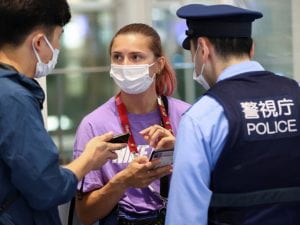
Belarus sprinter Krystsina Tsimanouskaya was scheduled by team officials for the women’s 4×400-meter relay.  She had never competed in the event before.  Tsimanouskaya posted criticism on social media for how the team was being managed, “with negligence.”  Tsimanouskaya would not complete the event.  Instead she would be told to pack her bags.  Further, that she would face punishment.

Alexander Lukashenko, dubbed “Europe’s last dictator,” was banned by the IOC from attending the Tokyo games.  IOC president Thomas Bach said, “we have come to the conclusion that it appears that the current leadership has not appropriately protected the Belarussian athletes from political discrimination.”  However, not only athletes.  In May a prominent blogger critical of Lukashenko was on a flight that was diverted, forced to land, arrested, and jailed.  But even more recently, one week after  Tsimanouskaya’s Instagram post, an activist by the name of Vitaly Shishov was found hanged in a park in Kiev.  

The threat was real.

Instead of boarding the plane back to Belarus, Tsimanouskaya was provided police protection.  According to the Economist, “The next day, Poland granted her and her family asylum. She claims that the call to send her back came not from the sports ministry but from “a higher level”. 

U.S. Secretary of State Antony J. Blinken summed it up best by, “denouncing Belarusian officials’ attempt to force Tsimanouskaya to return to Belarus for exercising free speech as ‘another act of transnational repression.’” Blinken would then ironically utilize a social media platform to express his views.  Much like Tsimanouskaya did.  “Such actions violate the Olympic spirit, are an affront to basic rights, and cannot be tolerated.”

Borrowed from: https://uk.anygator.com/article/belarusian-olympic-sprinter-%E2%80%98forced-to-return-home%E2%80%99-after-publicly-criticising-national-coaches-in-alleged-kidnappin__14862986


Roses Also Have Some Thorns

Vitalina Batsarashkina’s gold medal in the women’s 10 metre air pistol, an event I did not know even existed, triggered even more learning.  What country was ROC? After being lost in a rabbit hole of sorts, I came out with one big understanding.  There was a gaping loophole.  ROC stands for Russian Olympic Committee, a team of  333 Russian athletes.  Though banned as a country, Russian athletes still were able to compete in Tokyo.  Just not under the name, flag, or anthem of Russia.  However, the country’s colors for uniforms were permissible. “You don’t really need to have a strong imagination. In those uniforms that you saw, our national flag can be seen really really obviously,” Russian Olympic Committee president Stanislav Pozdnyakov said. 

ROC came about because in 2019, Russia  was banned from international competition for four years. World Anti-Doping Agency (WADA) President Witold Banka released in a statement, “The panel has clearly upheld our findings that the Russian authorities brazenly and illegally manipulated the Moscow Laboratory data in an effort to cover up an institutionalized doping scheme.”  The use of banned athletic performance-enhancing drugs, such as anabolic steroids.  The New York Times called it “one of the most elaborate — and successful — doping ploys in sports history.” Even an Oscar-winning documentary, Icarus, of the doping scandal hit Netflix. Yet, even after the facts were revealed and the verdict conclusive, the Court of Arbitration for Sport would later reduce the penalty to just two years.  Furthermore, they would plant the seeds for ROC, allowing Russian athletes to compete under a neutral flag if they proved they had no link to the doping scheme.

Zooming out, what did this add to the rancor of many athletes?  Lily King, gold medal and world record breaststroke swimmer, was quoted as saying, “I’m sure there were a lot of people competing this week from certain countries who probably shouldn’t have been here.”  Certain countries?  Hint. Hint.  Cough. Cough.  No prominent Russian swimmers were left home from the Games and Ryan Murphy, silver medalist in the 200 backstroke, did not mince words after coming in second.  “At the end of the day, I do believe there’s doping in swimming. That is what it is.” Again, a bit of an implication as the gold went to a swimmer from none other than, team ROC. An abbreviated version of a tweet on ROC’s page rebutted, “…Through the mouths of athletes offended by defeats. We will not console you. Forgive us those who are weaker. God is their judge. And for us – an assistant.” 


An Explanation that Empowers

Some may say Tokyo 2020 (or is it 2021?) was a flop. That the pandemic wreaked havoc on the games. The spectator less event a nadir to the sporting world and that even the host country could not get behind the Olympiad. Yet, all over the walls and in the cracks is evidence of success. The sharing of a gold medal, overcoming fear and pressure, courage and the freedom of speech, and inclusivity. Each of these in addition to the spirit of the Olympics, mutual understanding with a spirit of friendship, solidarity and fair play. Ubiquitous is whatever we look for, stories of encouragement or burden. Hopefully, the heroism and humanity of Barshim, Biles, Hubbard, Tamberi, and Tsimanouskaya is what we will choose to remember.  


####################


ACCREDITATION IS ALL ABOUT BEING BETTER

Being fully immersed in another school for five days is like no other professional development.  And it is available to us all.

“Creditum” in Latin means, “a thing entrusted to another.”  Fast forward from Roman days and to the United States at the end of the 19th century, where there was a push for  “accreditation.” The nature of the process being one where secondary schools were poked and prodded in effort to determine whether they could be entrusted with adequately preparing students for university.

Roughly a hundred and fifty years later, accreditation lives on.  The tenor centered more on reflection and support, and less on judgement.  Today, the United States Department of State has granted authorization to six regional non-profit accreditation agencies.  Recently I was invited to participate in my first virtual visit by one of these agencies, the Western Association of Schools and Colleges (WASC).

One word continually surfaced throughout the accreditation deep dive.

Impact.   

After examining everything the school said it did, we would do our best to tease it out in conversation.  We would also look for it in hallways, classrooms, and in conversations with students.  An effort to confirm to what degree programs and policies ultimately have a positive impact on student learning.

Accreditation days and nights are long. Initially, closely reading all the documentation is critical.  Looking for and triangulating evidence then ensues.  A vanguard of this “paper trail,” is to learn more about the extent reflection and collaboration played throughout the self-study process. Is the report a true reflection of the entire school community? Folders within Google doc folders are pored over. Questions likely surface and streams of notes are taken.  Accreditation members met with various smaller groups in effort to better understand the school. In these meetings, committee members moderate the discussion, often launching the conversation with “Can you please share with us how your team worked together to gather evidence on x, y, or z?”

Accreditation requires a 360-degree approach, one that truly is multi-dimensional. Learning from all stakeholders is essential.  This means:

~Leadership team (head of school and principals) ~Teachers
~Parents ~Support Staff
~Business Staff ~Building and Grounds
~Nursing Department ~Public Relations and Marketing
~Admissions ~Governance or board of directors (or governing company which was the case of the visit I partook in)

Beyond conversations with adults, some of the most telling evidence is out of the mouths of students, as they share more about their learning.  Impressively, many even talk about why and how they can apply this learning.  Busy daily schedules include time for the committee to debrief but also plan forward.  “After hours” are dedicated to contributing to the writing of the final report.

SO WHAT?  

Accreditation is a lot of work but the results are very gratifying. Moreover, I can think of no other venue to develop or improve skills.  People whom I have met with accreditation experience agree that there is no better professional development.  Here is a short but not comprehensive list of some of the skills incorporated in a school visit:

~Question development         ~Interview strategies              ~Formal writing

~Collaboration                         ~Presentation creation           ~Oral presentation

The visit I did was unique in several ways.  The nature of a virtual visit, itself is different. However, on our committee we were four members in three different time zones. This visit also happened to be the second ever dual commission visit (WASC and MSA~Middle States Association). Further, the school’s governing board which happens to be in Dubai, welcomed the participation of three evaluation specialists from the education ministry of Qatar. The amount of experience and expertise, combined with a high degree of mutual respect, ultimately led to a very thorough process.  One where collaboration, honest communication and consensus building were benchmarks.

NOW WHAT?  

At the end of the process, a school is provided with commendations. Celebration of these strengths is encouraged.  Additionally, critical areas of follow-up are included.  The final report with its action steps is often greatly appreciated, as it very well may be the needed wind in a school’s sails.  A sort of distilled and formalized plan for improvement moving forward.

The whole accreditation process is value added for all.  Professional development for committee members but of even greater importance is the role it provides in helping a school hold a mirror up to itself.  To reflect.  To be vulnerable.  To speak but also listen.  Then, to take a moment to celebrate before setting out on the path of betterment.  Because what it all comes down to, is self-improvement.  Schools ultimately focusing on improvement, to the benefit of all students and their learning.

########################

Note: Accreditation commissions welcome teachers to participate and I highly recommend it. Two commissions I have experience with are below. If interested, click on the following links:

www.acswasc.org/

www.msa-ces.orga/